3D laser printing with lunar dust
All eyes are currently on the Moon: with Artemis II, humans flew towards the Moon for the first time in more than 50 years. Plans for the development of the lunar surface are also intensifying worldwide. To build infrastructure on the Moon – such as landing pads and roads – requires different materials and processes from those established on Earth. Given the high cost of transporting cargo to the Moon, researchers are working to ensure the use of locally available materials for future production.
To this end, researchers from the Laser Zentrum Hannover (LZH) and the Technische Universität Berlin are investigating how solid structures can be created directly from lunar dust as part of the MOONRISE project. In a demonstrator mission, this dust – scientifically known as regolith – will be melted using a laser and then allowed to solidify in a compact form. This process is familiar from 3D printing. By scanning a dust-covered surface with the laser, flat structures can be produced. Artificial intelligence is used to analyse environmental conditions and the solidified material on the Moon, enabling researchers on Earth to carry out AI-based process and quality control.
Current development work spans a range of areas, from the production of synthetic lunar sand and the development of the laser melting process, to the design of a mission-specific spacecraft and the training of an artificial intelligence for image analysis.
At ILA, synthetic lunar sand in various compositions, melt samples and a model of the MOONRISE payload alongside a potential lander will be on display. MOONRISE is planned to be transported to the Moon as part of NASA’s Commercial Lunar Payload Services (CLPS) programme.
The project is funded by the German Space Agency at DLR using funds from the Federal Ministry of Research, Technology and Space (BMFTR).
Link:
German Aerospace Center (Deutsches Zentrum für Luft- und Raumfahrt; DLR)
German Space Agency at DLR
E-Mail contact-dlr@DLR.de
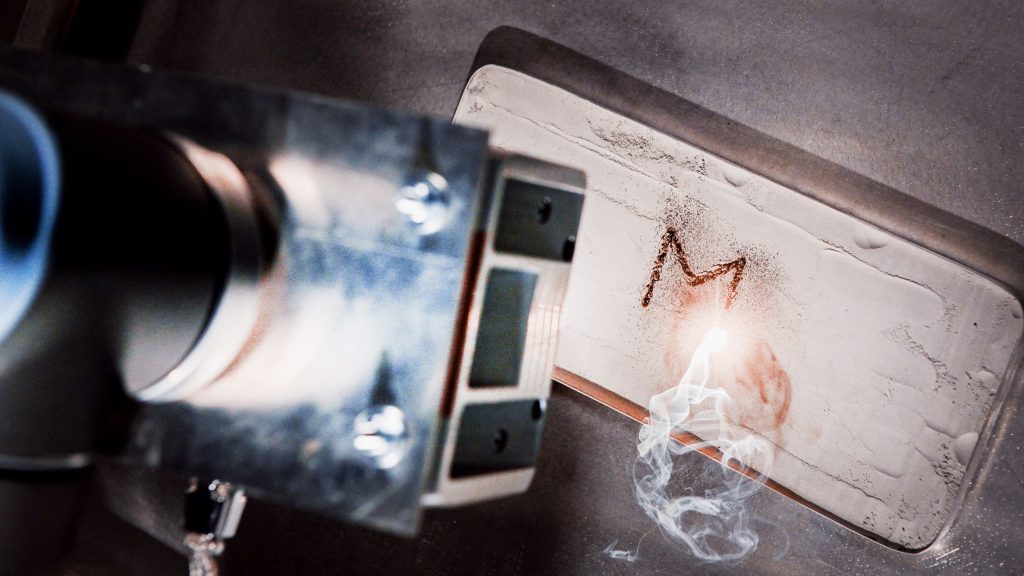
Der MOONRISE-Laser schmilzt im Labor erfolgreich ganze Bahnen aus künstlichem Regolith auf. (Foto: LZH)
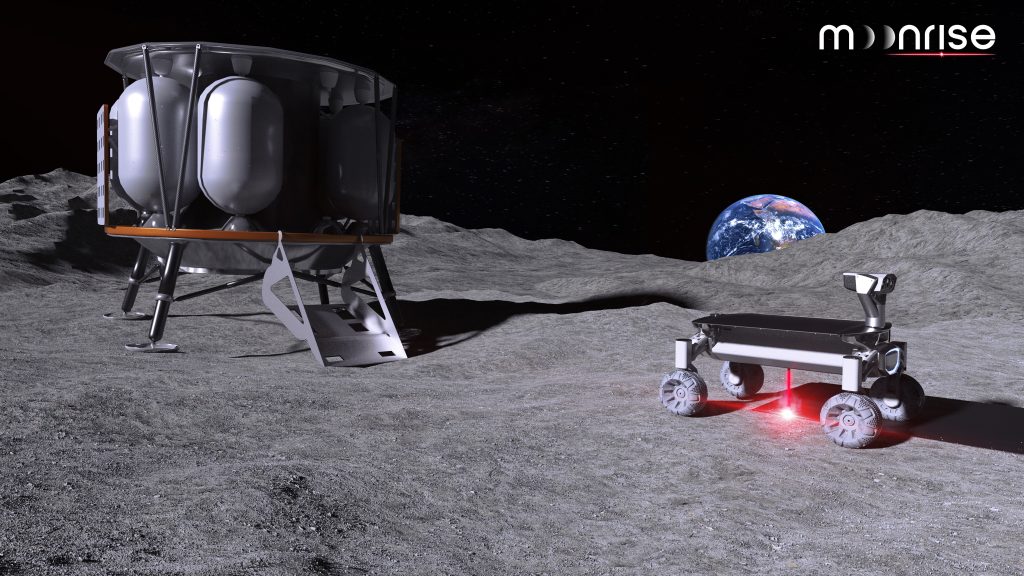
Perspektivische Verwendung für die MOONRISE-Technologie: Bei Einsatz auf dem Mond können feste Strukturen durch das Aufschmelzen von Regolith mit dem Laser erzeugt werden. (Grafik: LZH)