SALSAT
Spectrum AnaLysis SATellite
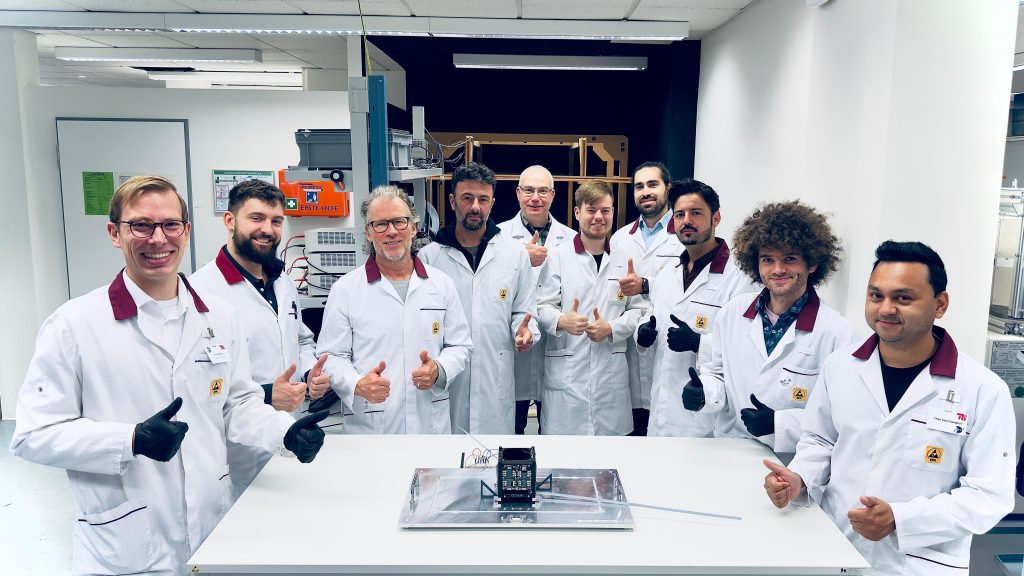
SALSAT is a nanosatellite mission from the Technische Universität Berlin, which aims to systematically map and analyse the use of the electromagnetic spectrum in Earth orbit. As the number of satellite-based applications continues to grow, the efficient and interference-free use of radio frequencies is becoming increasingly important.
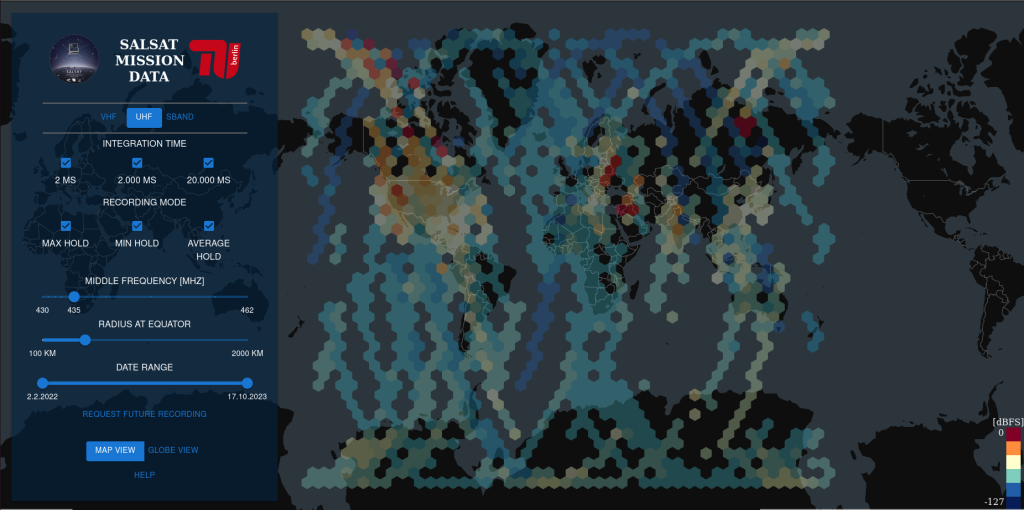
The mission measures spectral occupancy across various frequency bands. On board is a Software Defined Radio (SDR) that detects and characterises signals, evaluating them in terms of intensity as well as temporal and spatial distribution. This provides a detailed picture of current frequency usage in orbit.
SALSAT was launched in 2020 and operated for four years. During this period, extensive measurement data was collected, particularly in the amateur radio domain, with a focus on the UHF band. This data is available via an open-access database and can be retrieved both as raw data and as waterfall diagrams. Specific datasets for further analysis and future mission concepts can be made available.
This data contributes to a better understanding of interference and to the assessment of actual spectrum utilisation. It can contribute to the further development of regulatory approaches and frequency management for future space systems.
In addition to its scientific value, SALSAT serves as a technology platform for testing new approaches in the fields of on-board data processing, mission operations and system integration under real-world conditions. In this way, the mission also supports methodological development and academic training.
The RACCOON IOD project aims to further build on this approach. Several CubeSats will be deployed in a coordinated manner to spatially localise radio signals through triangulation. The launch of this mission is planned for 2028.
SALSAT is funded by the Federal Ministry of Research, Technology and Space (BMFTR) via the German Space Agency at DLR.
Link:
German Aerospace Center (Deutsches Zentrum für Luft- und Raumfahrt; DLR)
German Space Agency at DLR
E-Mail contact-dlr@DLR.de
CyBEEsat
Cybersecurity Berlin Experimental & Educational Satellite
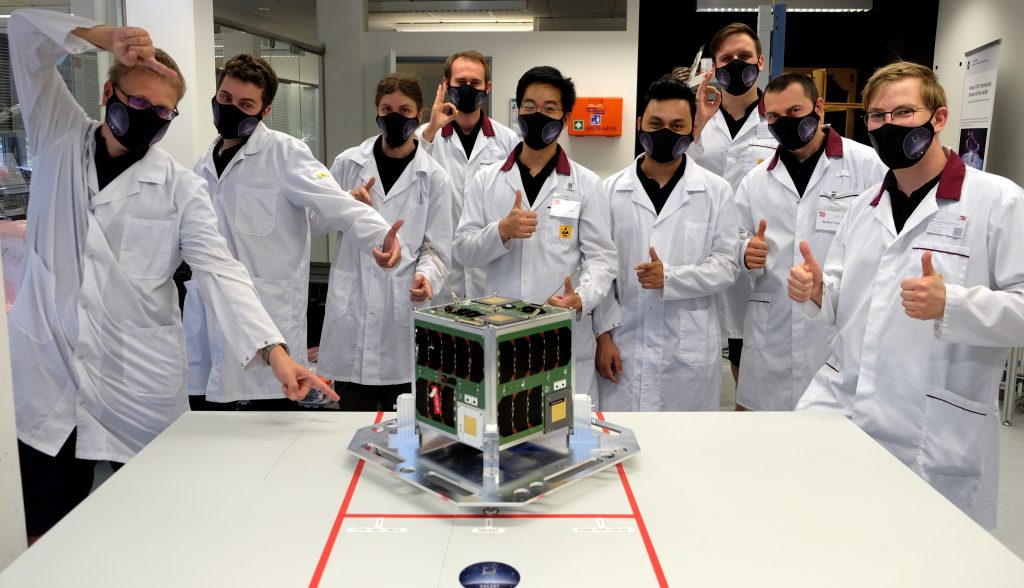
CyBEEsat is a 1U CubeSat mission led by the Technische Universität Berlin. It serves as a compact technology platform for testing new hardware and software for future small satellite missions, and as a precursor to further developments within the RACCOON project.
The mission focuses on several in-orbit technology demonstrations:
- Experimental perovskite solar cells from the University of Potsdam to investigate innovative radiation-tolerant photovoltaics in Earth orbit
- Cyber-OBC: a Linux-based, redundant onboard computer running RACCOON OS for secure and high-performance data processing
- VCOM: a VHF transceiver system operating in the Short Duration Mission (SDM) band
- Galactic EPS: a modern, redundant and fully passivatable power supply system
- Nutation damper: passive, fluid-dynamic attitude stabilisation
- AISEP: an additively manufactured structural and materials experiment for testing new manufacturing approaches for space applications
CyBEEsat enables novel systems to be validated under real space conditions at an early stage. At the same time, students and early-career professionals can be closely involved in development, integration, testing and mission operations. In this way, CyBEEsat demonstrates how even very small satellites can be used as cost-efficient technology platforms for research, education and industrial pre-development.
CyBEEsat is a joint project of the Space Technology department at TU Berlin and the Berlin Nanospacecraft Alliance (BNA). The mission is supported through collaboration with local start-ups, small and medium-sized enterprises (SMEs), the University of Potsdam and the commitment of numerous students. Project partners contribute largely without direct financial remuneration. The satellite’s launch is made possible through DLR’s Microlauncher Competition.
The RACCOON project is funded by the Federal Ministry of Research, Technology and Space (BMFTR) through the German Space Agency at DLR.
Link:
German Aerospace Center (Deutsches Zentrum für Luft- und Raumfahrt; DLR)
German Space Agency at DLR
E-Mail contact-dlr@DLR.de