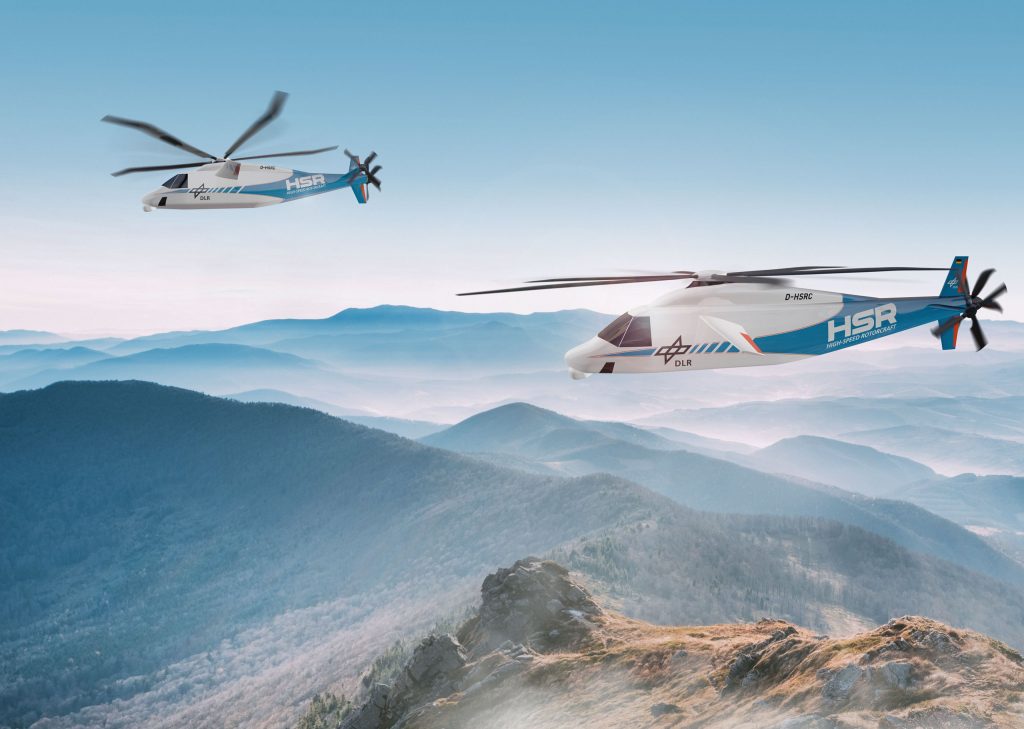
Configuration for faster transport helicopters
For several years, many countries have been investigating concepts to increase the flight speed of medium-weight transport helicopters.
As part of the High-Speed Rotorcraft (HSR) study, we at DLR have investigated how the speeds of conventional helicopters – typically around 300 kilometres per hour – can be significantly increased to up to 450 kilometres per hour.
Compared to conventional helicopters, the compound rotorcraft uses wings, propellers and control surfaces. This enables the main rotor to operate at a lower rotational speed during high-speed flight and to transfer the load to the wings. Combined with the decoupling of propulsion from the main rotor to the propellers, the rotor’s operating limits can be increased.
Our HSR design fulfils the same mission requirements in terms of payload and range as a contemporary medium transport helicopter in the ten-tonne class (UH-60 Black Hawk), but at significantly higher flight speeds. The analysis focuses on flight performance for various missions and scenarios in order to assess the suitability of such a high-speed helicopter for different operational concepts.
In addition, we are analysing the flight dynamics and developing new concepts for flight control and propulsion architecture.
Original design dimensions:
Maximum take-off mass: 15.7 tonnes
Main rotor diameter: 19.8 metres
Propeller diameter: 4.28 metres
Wing area: 13.8 square metres
Maximum continuous power output: 7080 kilowatts
Visitors to the DLR stand at ILA Berlin 2026 can find out more about the latest research into novel helicopter concepts, with a particular focus on the HSR configuration. The HSR model – with a rotor diameter of 1.24 metres and a length of just under 1.5 metres – illustrates the unique design of the high-speed configuration.
German Aerospace Center (Deutsches Zentrum für Luft- und Raumfahrt; DLR)
Institute of Flight Systems
E-Mail contact-dlr@DLR.de