Innovative electrolysis for a climate-compatible future
Hydrogen plays an important role in decarbonising energy-intensive industries such as steel, chemicals and heavy-duty transport. However, in light of rapidly increasing global demand – with forecasts predicting a hydrogen requirement of approximately 175 million tonnes by 2030 – current production methods are starting to reach their limits.
This is where the EU project PEPPER (Performant and Efficient Planar Proton-conducting Electrolysis Reactor) comes in – coordinated by us and to which we contribute our technical expertise. The aim is to develop a new generation of electrolysis technologies to produce hydrogen from renewable resources more efficiently and cost-effectively.
The focus is on planar Proton Conducting Ceramic Electrolysis Cells (PCCEL) operating at approximately 600 degrees Celsius. This comparatively high temperature makes it possible to use industrial waste heat, increasing the overall efficiency of the process. Compared to conventional liquid water electrolysis, the new technology reduces electricity consumption by up to 20 percent. The innovative planar cell design also enables a compact construction and high power density, and requires fewer critical raw materials, such as rare earth metals. Together, these advantages reduce long-term operating costs.
Our prime focus is on building a novel PCCEL stack. We are also developing a 3D simulation model to investigate the electrochemical processes in detail. Furthermore, we are contributing our extensive expertise in materials science, modelling and system integration to aid advances in cell technology.
Link:
German Aerospace Center (DLR)
Institute of Engineering Thermodynamics
Email contact-dlr@DLR.de
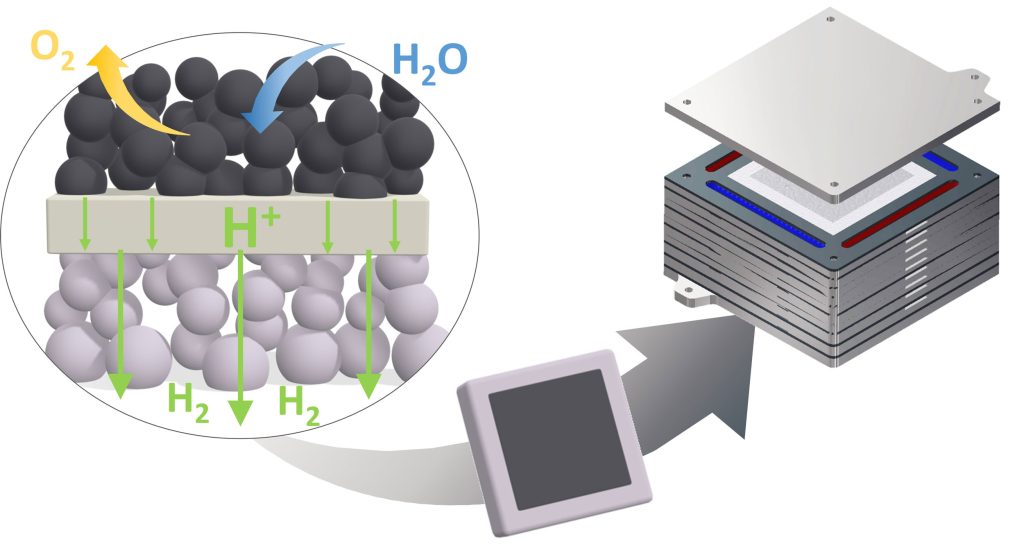
Planar Proton Conducting Electrolysis Reactor
Credit: ©DLR