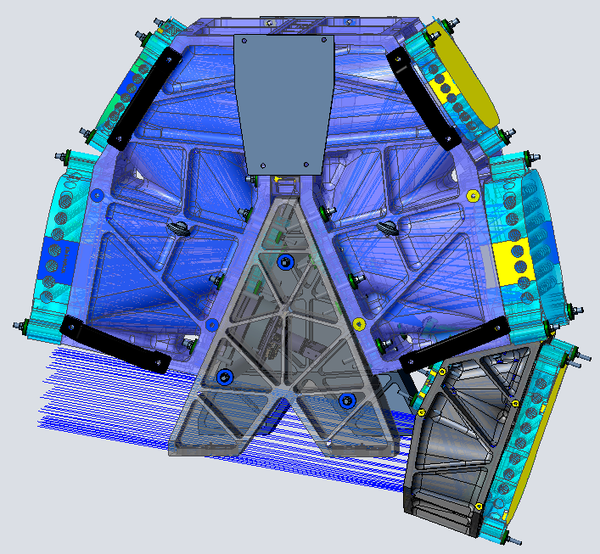
Optics of the German-Brazilian CO2Image satellite
Carbon dioxide (CO₂) and methane (CH₄) are the two most important greenhouse gases and the primary drivers of climate change. A large proportion of these emissions comes from ‘point sources’: in the case of CO₂, these include individual coal or gas-fired power stations and industrial plants, while CH₄ sources include landfill sites and oil and gas extraction plants. Small and medium-sized point sources in particular – which account for the largest share of greenhouse gas emissions from such installations – cannot currently be monitored independently. The German-Brazilian satellite mission CO2Image is designed to address this gap. In the future, it will survey these point sources from space and measure their emissions.
To do this, the CO2Image satellite captures an image of, for example, a power station and its exhaust plume from above. The image is acquired in the infrared region of the light spectrum, in which CO₂ and CH₄ are visible. Sunlight that has passed through the atmosphere and the power station’s exhaust plume is captured by a high-resolution spectrograph, which generates an image with a ground resolution of 50 by 50 square metres, including all CO₂ and CH₄ sources present there.
The exhibit shows the design of COSIS, the spectrograph of the CO2Image mission. Using a system of high-precision mirrors, light is directed onto a detector of approximately 1000 by 1000 pixels and split into its spatial and spectral components. The spectrograph records only a single line of the image at a time. The complete image, comprising approximately 1000 lines, is created by rotating the entire satellite so that this image line is progressively shifted across Earth’s surface. The whole process takes approximately 90 seconds.
CO2Image is a joint mission involving several DLR institutes and the Brazilian National Institute for Space Research (INPE ). DLR provides the COSIS payload and INPE supplies the P100 satellite platform. The data will be jointly analysed by researchers at DLR and INPE and subsequently made freely available to the public.
Link:
German Aerospace Center (Deutsches Zentrum für Luft- und Raumfahrt; DLR)
Institute of Atmospheric Physics
Institute of Space Research
German Remote Sensing Data Center
Remote Sensing Technology Institute
Space Operations and Astronaut Training institute
E-Mail contact-dlr@DLR.de