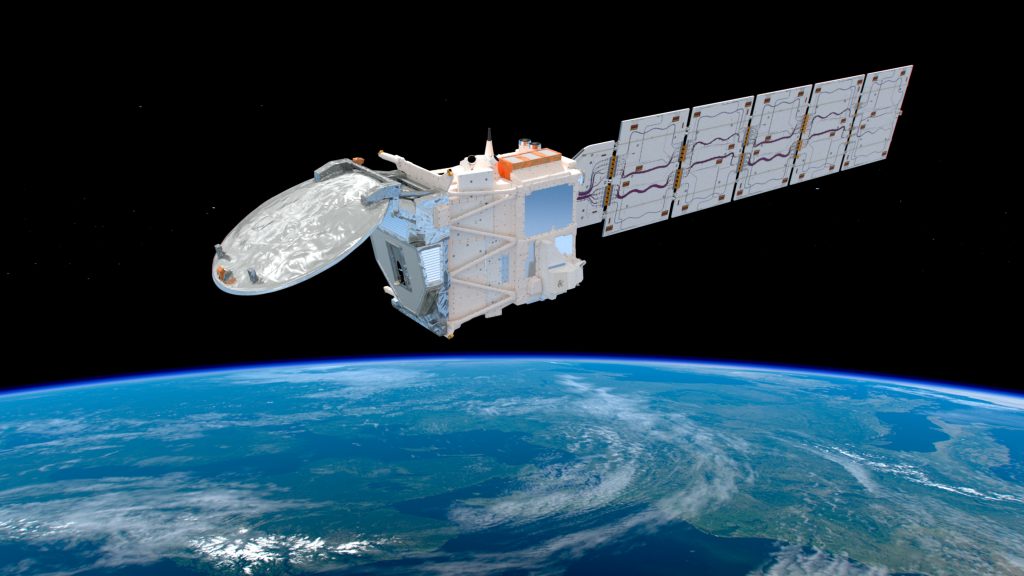
Tracing the interactions within Earth’s atmosphere
Whether it’s drought and heat in southern Europe or extreme rainfall events in Germany – solar radiation is a key factor in climate patterns and weather dynamics, as it drives atmospheric circulation. However, this radiation is distributed very unevenly and interacts with clouds, trace gases and aerosols – suspended particles composed of tiny solid and liquid particles. To make even more accurate forecasts in the near future, we need a better global understanding of aerosol and cloud parameters and must unravel their interactions within Earth’s atmosphere. Combined with measurements of radiation density, this will provide more precise insight into the radiation budget of our home planet.
To this end, the European Space Agency (ESA), in collaboration with the Japan Aerospace Exploration Agency (JAXA), launched the EarthCARE Earth observation satellite (Earth Cloud Aerosol and Radiation Explorer) in 2024.
During the commissioning phase, the DLR research aircraft HALO (High Altitude and Long Range Research Aircraft) conducted a joint campaign with the Max Planck Institute for Meteorology in parallel with EarthCARE operations to validate the satellite data. As part of the GIVE project, researchers will examine the data products and their quality in detail.
The German Space Agency at DLR is significantly involved in the EarthCARE mission through funding from the Federal Ministry of Research, Technology and Space (BMFTR) – a mission within ESA’s FutureEO Earth observation programme, in which Germany is the programme leader and has contributed several hundred million euros to date. Additional funding from the German Space Programme is being provided to prepare for the use of EarthCARE data by researchers and a project office during operations, and to support German research institutions and universities in making use of the data.
Link:
German Aerospace Center (Deutsches Zentrum für Luft- und Raumfahrt; DLR)
German Space Agency at DLR
E-Mail contact-dlr@DLR.de