Searching for dark matter and dark energy
The European Euclid mission launched in 2023 and will observe more than ten billion galaxies, along with their evolution and distribution over the last ten billion years. Researchers hope to gain insights into the influence of dark matter and dark energy on the structure of the Universe.
Dark matter influences the gravitational interactions between and within galaxies. It plays a crucial role in the formation and evolution of galaxies and, due to its gravitational pull, slows down the expansion of the Universe. Dark energy, by contrast, drives the accelerated expansion of the Universe and counteracts the gravitational pull of dark matter. By understanding this complex interplay, researchers aim to learn more about the nature of dark matter and dark energy – as it remains unclear what they are made of and how they interact with one another.
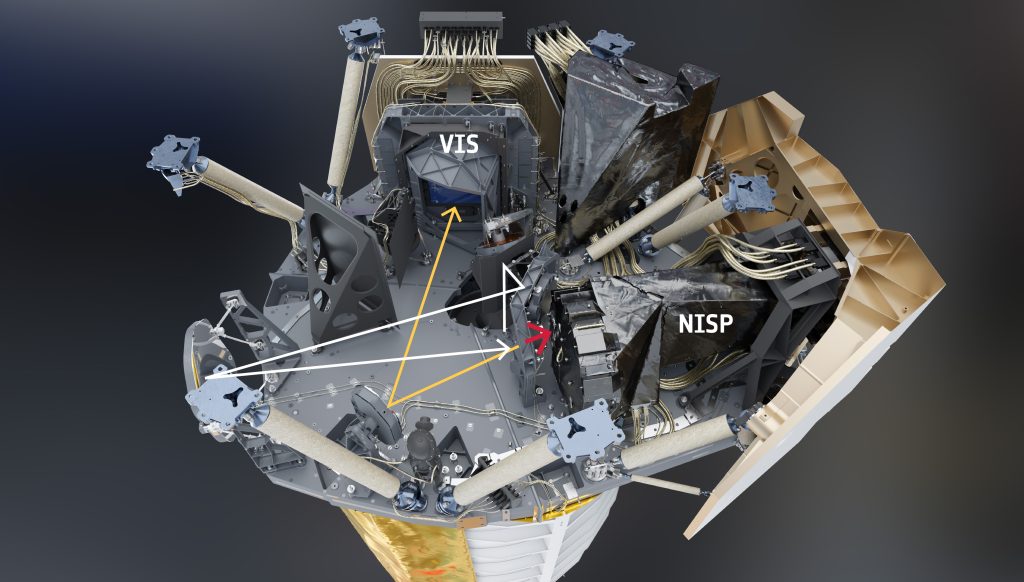
The Euclid spacecraft is equipped with a telescope and two instruments: the Near Infrared Spectrometer and Photometer (NISP) and the Visible Instrument (VIS). They provide detailed analyses of millions of galaxies, enabling their distance and three-dimensional position in the Universe to be derived.
The NISP instrument was developed in collaboration with the Max Planck Institute for Astronomy in Heidelberg and the Max Planck Institute for Extraterrestrial Physics in Garching. Both institutes, along with Ludwig Maximilian University in Munich, the University of Bonn and Ruhr University Bochum, are also involved in the software development for Euclid and all have contributed substantial funding to the mission.
The German Space Agency at DLR, as the largest contributor, is financing the six-year mission using funds from the Federal Ministry of Research, Technology and Space (BMFTR).
The Max Planck Institutes for Extraterrestrial Physics and Astronomy, Ruhr University Bochum and Ludwig Maximilian University Munich are involved in researching galaxies using data from Euclid.
Link:
German Aerospace Center (Deutsches Zentrum für Luft- und Raumfahrt; DLR)
German Space Agency at DLR
E-Mail contact-dlr@DLR.de