Measuring shifts in global water masses from space
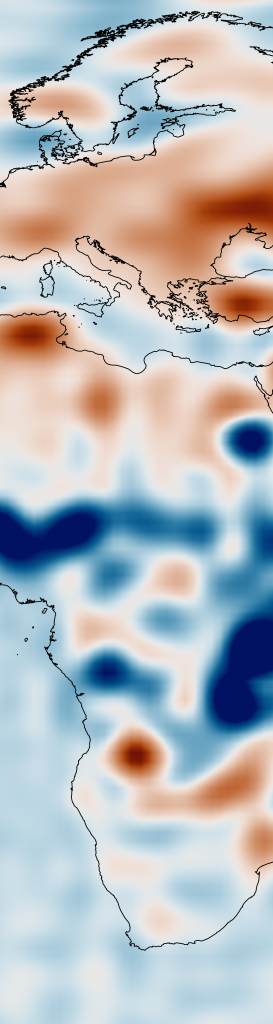
Along with clean air, water is one of the most vital resources we have on Earth. Yet groundwater levels around the world are constantly changing. From 2028, the German-American GRACE-C satellites (Gravity Recovery and Climate Experiment – Continuity) will record every change in these mass movements globally with such precision that researchers will be able to measure Earth’s water balance with extraordinary accuracy and consistency. GRACE-C will continue the invaluable data collection of the GRACE and GRACE-FO missions, whose data form part of the scientific basis for the reports of the Intergovernmental Panel on Climate Change.
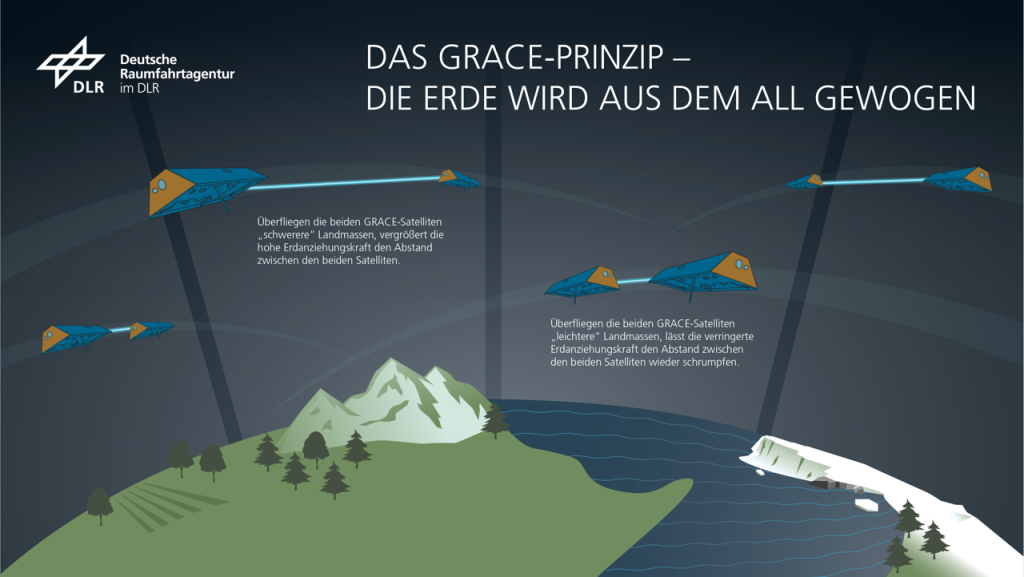
At the heart of the GRACE-C mission is the precise measurement of very small distance variations between the two satellites as they orbit Earth. In the case of GRACE-C, this distance is determined using laser interferometry. The pair of satellites detects masses solely through their gravitational pull. To do this, the two spacecraft fly one behind the other at an average distance of only approximately 220 kilometres. The relative distance variations and speed of the two GRACE-C probes will be constantly and precisely measured using lasers, achieving an accuracy of 200 to 300 picometres – roughly the size of an atom.
On the German side, the GeoForschungsZentrum (GFZ) in Potsdam and the Max Planck Institute for Gravitational Physics (Albert Einstein Institute; AEI) in Hannover are involved. The satellites are being built by Airbus in Friedrichshafen on behalf of NASA’s Jet Propulsion Laboratory (JPL), with key instrument components supplied by SpaceTech GmbH in Immenstaad (STI). The launch of the new GRACE-C satellites is planned for 2028. DLR’s German Space Operations Center (GSOC) in Oberpfaffenhofen will take over mission control.
The German mission contributions are being implemented by the German Space Agency at DLR with funds from the Federal Ministry of Research, Technology and Space (BMFTR).
Link:
German Aerospace Center (Deutsches Zentrum für Luft- und Raumfahrt; DLR)
German Space Agency at DLR
E-Mail contact-dlr@DLR.de