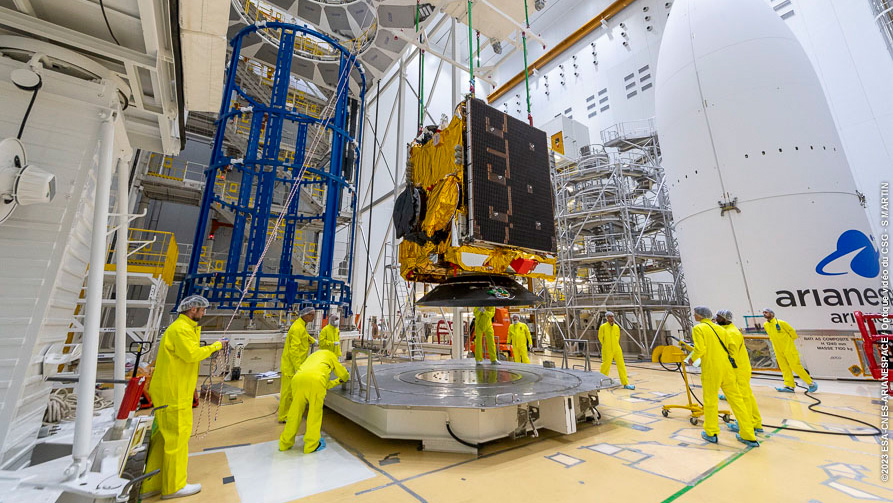
First German satellite mission for researching new communications technologies
The Heinrich Hertz mission saw Germany’s first communications satellite launch in 2023, dedicated to researching and testing new technologies and communications scenarios.
For the telecommunications satellite market in Germany – a technology hub – Heinrich Hertz represents a significant boost: the diverse German space industry benefits from its development and numerous European companies are also involved in the project.
The findings from the Heinrich Hertz mission can, together with other technological advances, also be applied to smaller, low-flying satellites that are manufactured cost-effectively and in series production. The mission is also an important step in the field of smart satellites. Its results can help to further advance the flexibility and digitalisation of satellite communications technology. Current topics such as artificial intelligence, quantum communications and flexible antenna technology for mega-constellations can be prepared for in this way. The mission thus also contributes to the information society in Germany.
The Heinrich Hertz mission is led by the German Space Agency at DLR on behalf of the Federal Ministry of Research, Technology and Space (BMFTR), with the involvement of the Federal Ministry of Defence (BMVg). OHB-System AG was commissioned to develop and build the satellite. The companies IABG GmbH, MDA AG and TESAT GmbH & Co. KG are also involved in the development and testing of the satellite. OHB Digital Connect, in collaboration with CGI, is responsible for the ground segment, including the control centre in Bonn. The new ground stations are located in Hürth (North Rhine-Westphalia) and Neustrelitz (Mecklenburg-Vorpommern). A total of 42 partners are involved in the mission – 14 of them on the scientific payload.
Link:
German Aerospace Center (Deutsches Zentrum für Luft- und Raumfahrt; DLR)
German Space Agency at DLR
E-Mail contact-dlr@DLR.de