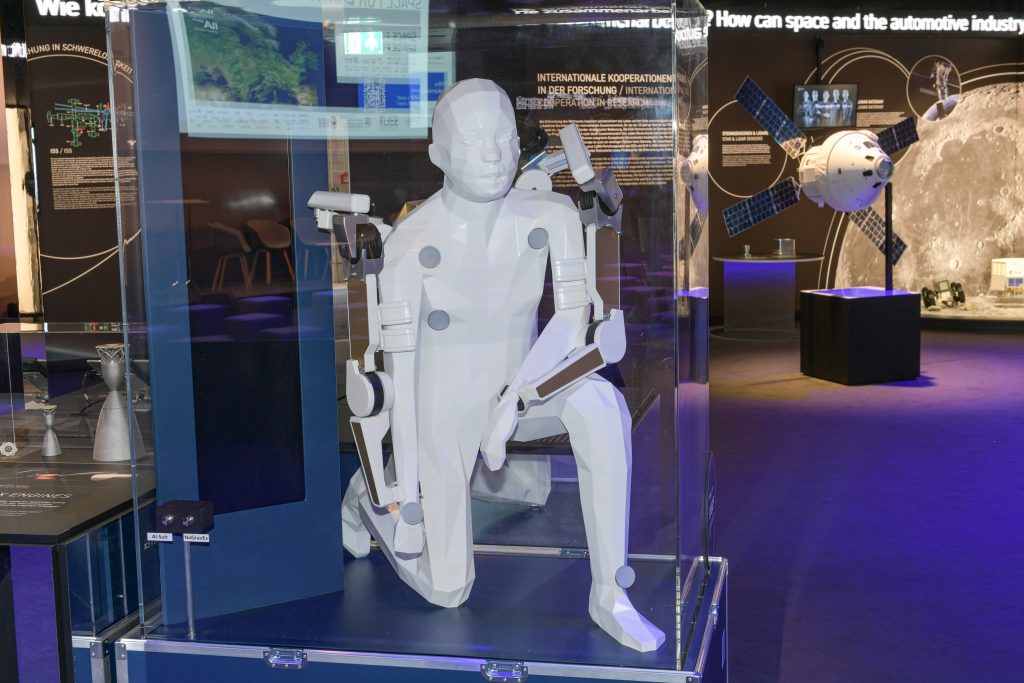
AI-controlled exoskeleton and vital sign monitoring
Technology developed for space does not necessarily have to stay in space. Many innovations have, as ‘spin-offs’, long been making our everyday lives and research on Earth easier – giving rise to better engines, robots, sensors and computers. Two of these technological developments are presented in the interactive exhibit ‘INNOvital’.
As part of the ‘NoGravEx’ and ‘GraviMoKo’ projects, an AI-supported exoskeleton is being developed for astronaut training in space and, simultaneously, for rehabilitation on Earth. With the ‘AI-Suit’, a microelectronic sensor patch system for space suits records the wearer’s vital signs.
For ILA 2026, INNOvital has been expanded to include a 1:1 scale AI-supported exoskeleton that includes the life-size figure ‘Robin’ in the AI-Suit spacesuit and a replica of the sensor patch system.
INNOvital was developed as part of the INNOspace network and is funded by the German Space Agency at DLR with funds from the Federal Ministry of Research, Technology and Space (Bundesministerium für Forschung, Technologie und Raumfahrt; BMFTR). The Faculty of Engineering at the University of Duisburg-Essen is leading the NoGravEx and GraviMoKo projects, which will further develop the exoskeleton and test it under various gravitational conditions. The exhibit showcasing the AI-based sensor system is presented by the Fraunhofer Institute for Electronic Nano Systems.
Link:
German Aerospace Center (Deutsches Zentrum für Luft- und Raumfahrt; DLR)
German Space Agency at DLR
E-Mail contact-dlr@DLR.de