Japan Aerospace Exploration Agency (JAXA)
The Japan Aerospace Exploration Agency (JAXA) is Japan’s national research and development agency. Driven by science and technology, it aims to lead society forward and create lasting value. JAXA carries out a wide range of activities, from basic research to the development and application of space technologies and spaceflight.
Recent highlights from JAXA include the successful launch of the Global Observing SATellite for Greenhouse gases and Water cycle (GOSAT-GW) aboard the final H-IIA Launch Vehicle No. 50 in June 2025, marking the end of a quarter century of H-IIA launch missions.
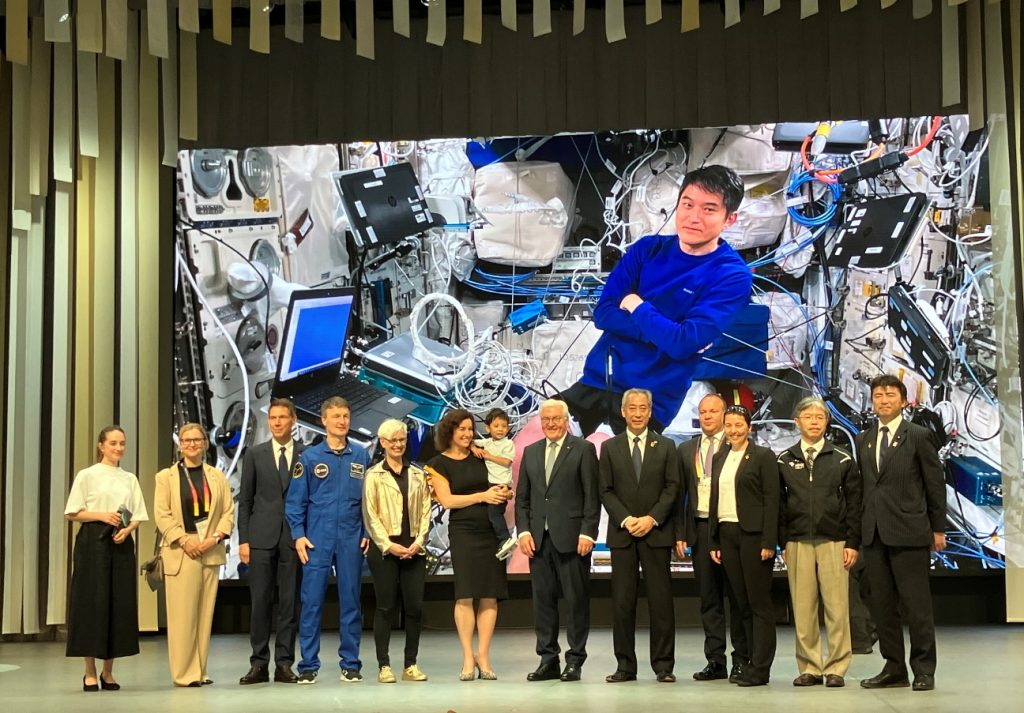
That same month, DLR and JAXA celebrated the German ‘National Day’ celebration at Expo 2025 in Osaka, Kansai, with the special event ‘Beyond Planet Earth – German-Japanese Cooperation in Space’. The event highlighted the close ties between the two countries and featured a message from ISS astronaut Takuya Onishi, who emphasised the importance of international collaboration on the space station.
The new uncrewed cargo spacecraft HTV-X1 completed its inaugural flight aboard the seventh H3 launch vehicle (H3 F7) in October 2025. The HTV-X1 successfully docked with the International Space Station and delivered its cargo.
JAXA will continue to advance Japan’s activities in space and launch significant missions that contribute to the future of humanity.
Martian Moons eXploration (MMX) Mission
The world’s first sample return mission from the Martian moon Phobos
The Martian Moons eXploration (MMX) mission is a project to explore the two moons of Mars. Approximately one year after leaving Earth, the spacecraft will arrive at Mars and enter orbit around the Red Planet. It will then transition into a ‘quasi-satellite orbit’ around the Martian moon Phobos to collect scientific data and take a sample from its surface. After observing and collecting samples from Phobos, the probe will return to Earth.
The MMX launch is currently planned for 2026, with Mars orbit insertion in 2027 and return to Earth in 2031. The spacecraft carries 13 instruments to study both moons and the Martian environment, developed by NASA and the French space agency CNES.
MMX will also carry the Idefix rover, jointly developed by DLR and CNES. Idefix will explore the surface of Phobos before MMX lands to collect samples. This will provide in-situ data about the moon and significantly improve the safety of the landing.
Exploring the Martian moons will help advance the technologies needed for future planetary and satellite exploration – for example through the further development of technologies for round trips between Earth and Mars, and advanced surface sampling techniques to be applied on the surface of the Martian moon. Communications technologies will also be optimised with the support of NASA’s Deep Space Network (DSN) of ground stations.
A key scientific objective of the mission is to shed light on the origin of the two Martian moons and the evolution of the ‘Mars sphere’ (Mars, Phobos and Deimos). MMX will also help investigate the migration process of organic matter and water in the early Solar System and clarify how they were delivered to these celestial bodies.
H3 Launch Vehicle
A world leader in space transport
The H3 launch vehicle is Japan’s next-generation heavy-lift rocket. It was developed as the successor to the H-IIA to continue transporting satellites, probes and other spacecraft safely and reliably.
Its first successful launch took place on 17 February 2024, when the rocket, named H3TF2 (H3 Launch Vehicle Test Flight No. 2), flew as planned. It successfully completed all mission objectives including second-stage orbital insertion, separation of two piggyback satellites and a controlled re-entry.
The next launch, scheduled for June 2026, is a test mission in the ‘Type 30’ configuration, featuring three LE-9 engines and no solid rocket boosters. The aim is to reduce launch costs and improve flexibility. The rocket will carry payloads including small satellites to demonstrate new technologies and flight performance.
In recent years, many satellites with a direct impact on daily life have been placed into orbit, making the use of space an integral part of modern society. In this context, H3 is designed to become a launch vehicle that attracts attention not only in Japan but worldwide – as an easy-to-use space transport system. To achieve this, JAXA aims to make H3 highly flexible, reliable and cost-effective.
JAXA offers two types of fairing and either two or three first-stage engines (LE-9), along with zero, two or four solid rocket boosters (SRB-3), to accommodate a range of payload sizes to be placed into their respective orbits. H3 can deliver a payload of at least 6.5 tonnes to geostationary transfer orbit, surpassing the capabilities of the H-IIA and H-IIB launch vehicles.
Main specifications
Length: 63m (Long type (L)), 57 m (Short type (S))
Core vehicle diameter: 5.2 m
Total mass (without payload): 575 t(H3-24L)
Fairing: Long type (L), Short type (S)
PAF diameter: 937 mm, 1194 mm, or 1666 mm
Launch capability
4 tonnes or even more to Sun-synchronous orbit (SSO)
6.5 tonnes or even more to geostationary transfer orbit (GTO) (ΔV=1500 m/s)
JAXA Public Affairs Department
E-Mail PROFFICE@jaxa.jp