Quantum optical magnetometer for space and Earth
Quantum sensors exploit effects from quantum physics to achieve unrivalled precision and sensitivity when measuring physical quantities. They offer a wide range of potential applications – both in space and on Earth. Germany’s High-Tech Agenda therefore aims to promote quantum sensors as a key technology for medical engineering and other fields.
The quantum magnetometers developed within the MyoQuant project can measure minute magnetic field changes within a small volume with spatial resolution and in a virtually contactless manner. They significantly outperform existing systems in terms of bandwidth, speed and robustness against background fields.
On display at ILA is the sensor head developed by the Ferdinand-Braun-Institut Berlin. It is suitable for field use and has a total volume of approximately seven millilitres, consisting of a caesium vapour cell within a compact micro-optical system. The sensor achieves sensitivities in the sub-pT/√Hz range.
Quantum magnetometers open up new possibilities in biomedical research – for instance, diagnosing muscular fatigue or measuring brain and cardiac activity. During long-term stays in space, extended periods of microgravity can lead to a decline or change in muscle tissue, which quantum magnetometer measurements can detect at an early stage. Such non-invasive measurement of muscle activity also holds great potential for applications on Earth, for example in diagnosing neuromuscular disorders. Beyond the detection of biomagnetic signals, there are numerous further applications, including industrial sensing and geophysical surveys.
MyoQuant is a collaborative project funded by the German Space Agency at DLR on behalf of the Federal Ministry of Research, Technology and Space (BMFTR), involving the Ferdinand-Braun-Institut Berlin (FBH), the Physikalisch-Technische Bundesanstalt and the University of Tübingen.
Link:
German Aerospace Center (Deutsches Zentrum für Luft- und Raumfahrt; DLR)
German Space Agency at DLR
E-Mail contact-dlr@DLR.de
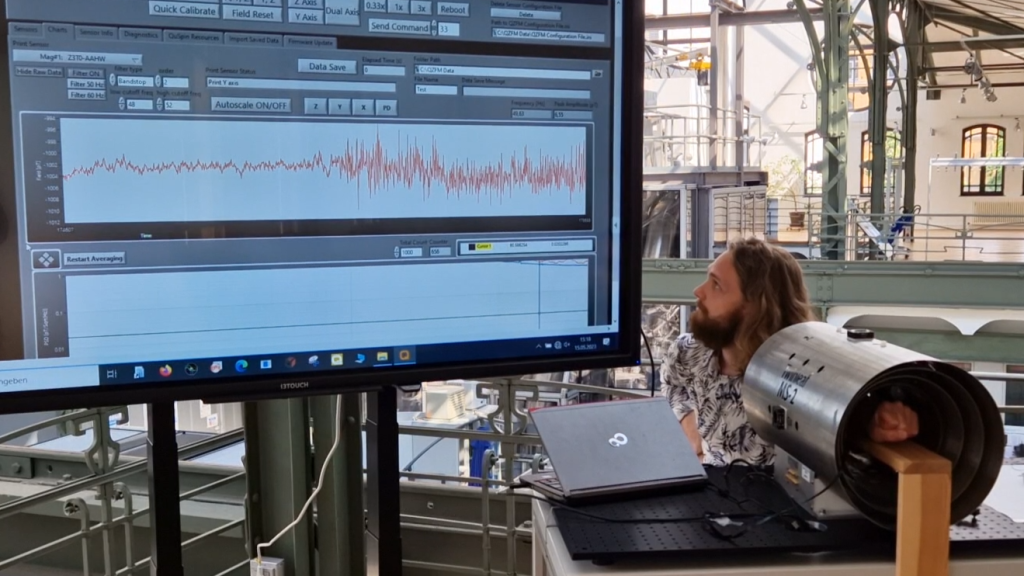
Eine Versuchsperson testet ein Magnetomyografie-System mit einem Arm in der magnetischen Abschirmung. Die magnetische Signalstärke wird auf dem Monitor dargestellt. (Foto: PTB)
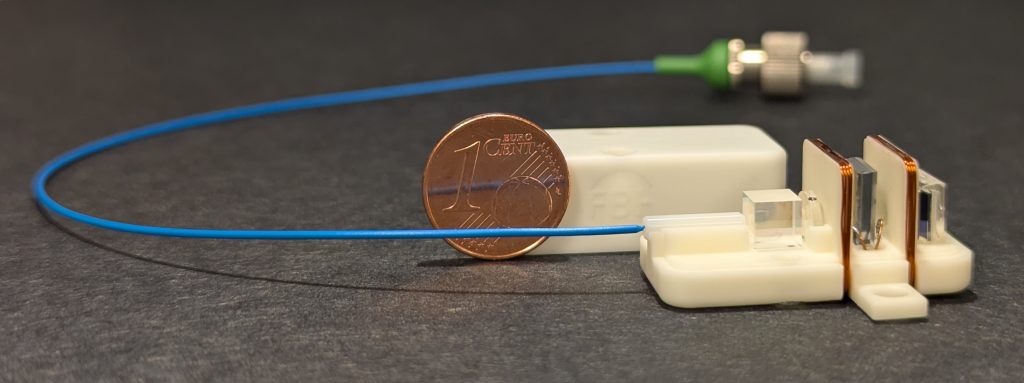
Der geöffnete Sensorkopf des optisch gepumpten Magnetometers (Volumen 7 mL) mit einem 1-Cent-Stück als Größenvergleich. Über die Faserkopplung (blau) können die Lichtquelle sowie die Detektionselektronik angeschlossen werden, was die Nutzung in moderat abgeschirmten Umgebungen erlaubt. (Foto: FBH)