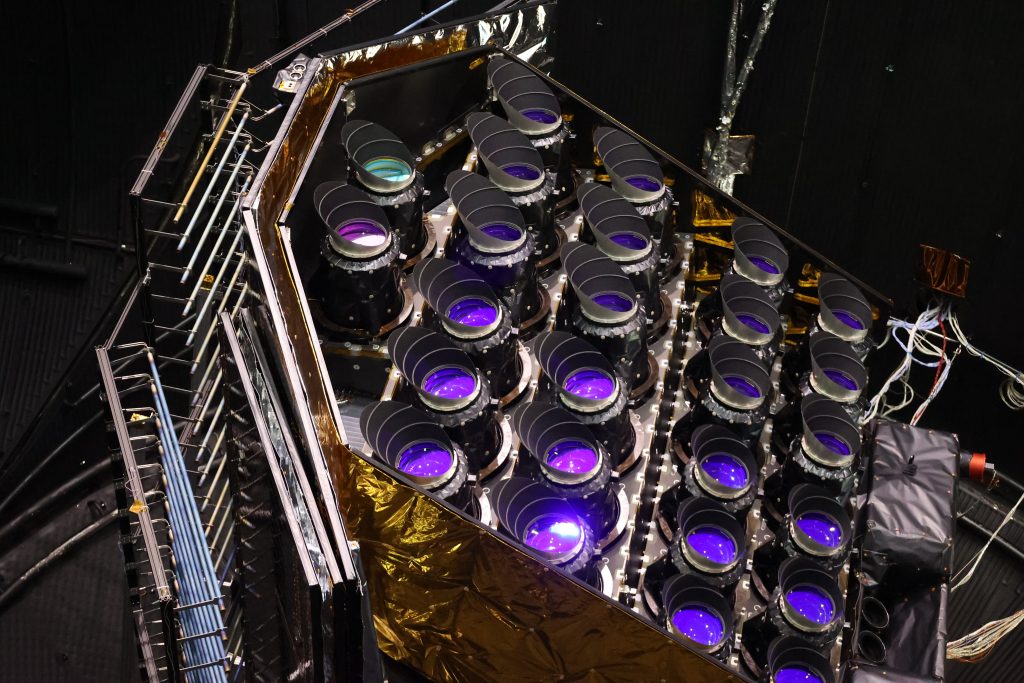
The exoplanet-hunting camera
The European PLATO mission (PLAnetary Transits and Oscillations of stars) is designed to detect Earth-like planets orbiting Sun-like stars in the Milky Way that may even have conditions necessary for life. To achieve this, the upper stage of the Ariane 6 launch vehicle will transport PLATO to ‘Lagrange’ (or libration) point 2 in 2027. Using 26 cameras, the probe will record tiny variations in the brightness of up to one million stars as planets pass in front of them – causing a slight, but measurable, dimming of their light. The goal is to discover Earth-like planets, in particular to better understand how Earth itself formed.
PLATO features an unusual design for astronomical observations from a space-based platform: instead of a single telescope with a large primary mirror and detector in the focal plane, 26 individual lenses with cameras are mounted on an ‘optical bench’ to expand the field of view.
Germany’s contribution to PLATO is jointly funded by the German Space Agency at DLR, through grants from the Federal Ministry of Research, Technology and Space (Bundesministerium für Forschung, Technologie und Raumfahrt; BMFTR) and with core funding provided by DLR and the Max Planck Society. The DLR Institute of Space Research is leading the PLATO payload consortium, developed and delivered the data readout and processing electronics as well as the data-processing electronics for two mission-critical cameras, and is heavily involved in the scientific research.
The spacecraft was built and assembled by the industrial PLATO core team under the leadership of prime contractor OHB Bremen, together with Thales Alenia Space and Beyond Gravity. The Max Planck Institute for Solar System Research in Göttingen is responsible for the development and operation of the PLATO Data Center (PDC), which will carry out the calibration and validation of PLATO observations and generate high-quality data products.
Link:
German Aerospace Center (Deutsches Zentrum für Luft- und Raumfahrt; DLR)
DLR Institute of Space Research
E-Mail contact-dlr@DLR.de