ESA spacecraft on its way to Jupiter’s icy moons
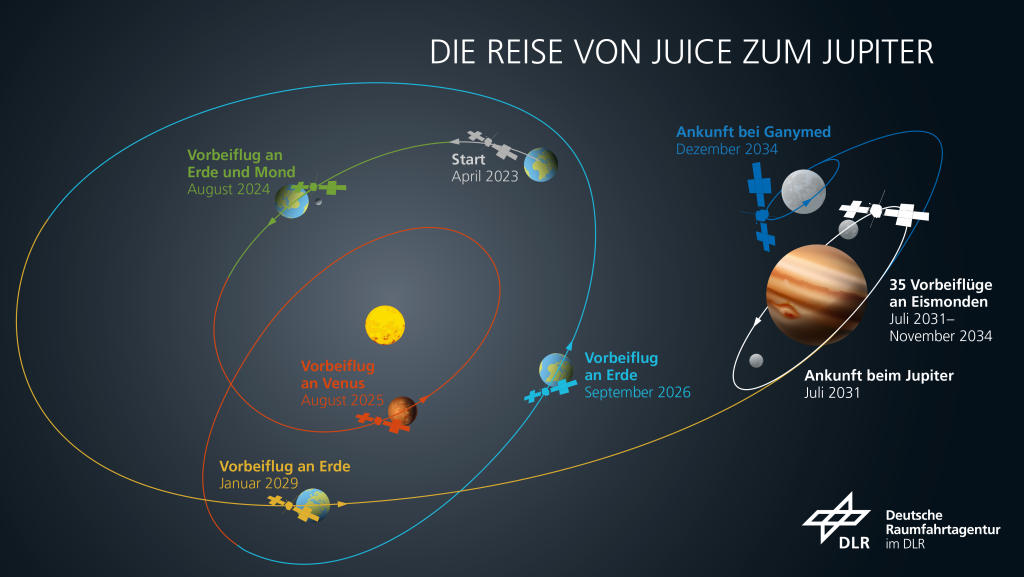
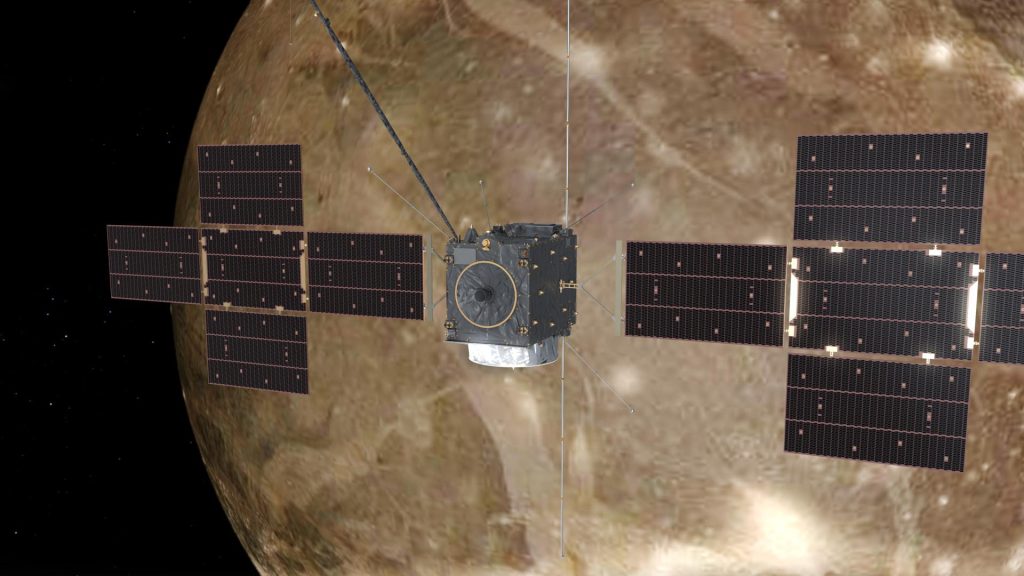
On 14 April 2023, the JUICE (JUpiter ICy Moons Explorer) large-class mission launched into space. The objective of the European Space Agency’s (ESA) largest planetary mission to date is to explore Jupiter and its large icy moons Ganymede, Callisto and Europa. JUICE is set to study them up close from 2031 onwards. Beneath the icy crusts of these moons, there are likely oceans in which life could even exist.
The GALA instrument’s main task is to map the topography of Ganymede and to detect Jupiter’s tidal effects on the icy surface and the ocean within. JANUS will map the entire surface of Ganymede and, during fly-bys, capture high-resolution images of the surfaces of Europa and Callisto on a global and regional scale. JANUS will also characterise Jupiter’s atmosphere, the surface of Io – the most volcanically active body in the Solar System – Jupiter’s numerous small moons and its ring system.
The SWI instrument was developed under the leadership of the Max Planck Institute for Solar System Research (MPS) in Göttingen. PEP is a spectrometer for measuring neutral and charged particles in the Jupiter system (MPS, Göttingen). J-MAG is a magnetometer for characterising the magnetic fields of Jupiter and Ganymede and for investigating the icy moons’ oceans (Technische Universität Braunschweig). The RIME radar instrument is designed to investigate the internal structure of the icy moons down to a depth of nine kilometres (Technische Universität Dresden). 3GM is a radio wave experiment with a Ka-band transponder and ultra-stable oscillator for determining the gravitational fields and atmospheres of Jupiter and its moons (RIU, University of Cologne).
Germany is playing a key role in the JUICE mission. The German Space Agency at DLR is supporting JUICE with funding from the Federal Ministry of Research, Technology and Space (BMFTR), contributing the largest single share of any ESA Member State – approximately 21 percent. These funds form part of the financing for the development of the spacecraft, its launch on an Ariane 5 rocket and mission operations. In addition, approximately 100 million euros are being invested in Germany’s contributions to seven of the mission’s ten scientific instruments and one experiment aboard the spacecraft.
DLR’s research is represented in JUICE through the Institute of Space Research, with contributions to the GALA (Ganymede Laser Altimeter) instrument and the JANUS camera, as well as through further scientific team memberships, some of which are funded by the German Space Agency at DLR.
Link:
German Aerospace Center (Deutsches Zentrum für Luft- und Raumfahrt; DLR)
German Space Agency at DLR, Space Exploration
E-Mail contact-dlr@DLR.de