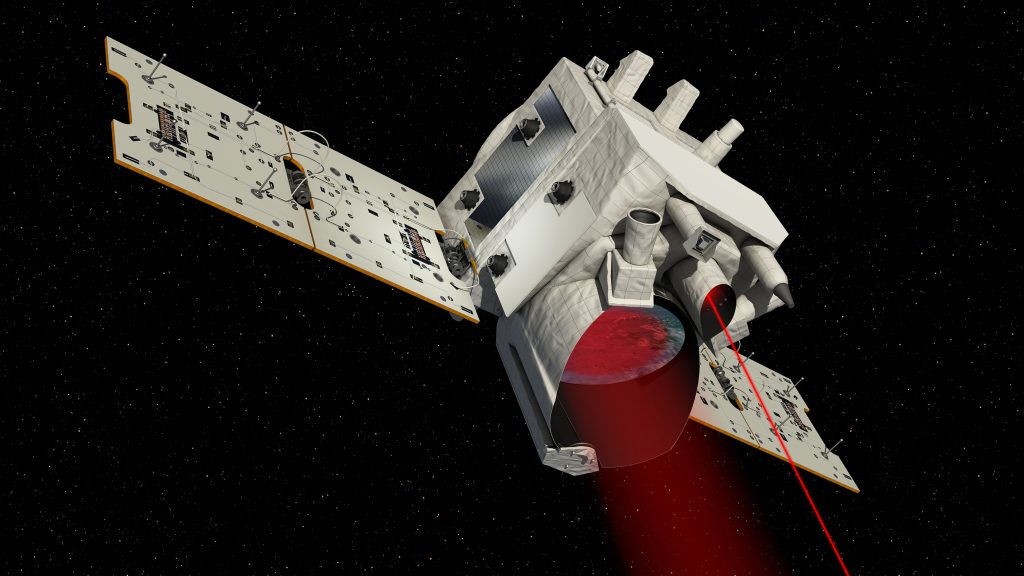
German-French small satellite for detecting methane
The German-French small satellite MERLIN (Methane Remote Sensing Lidar Mission) is a climate mission scheduled to launch in 2030.
The aim of the three-year mission is to measure methane concentrations across the globe with high precision. It is intended to provide information on the regions of Earth where methane is released into the atmosphere (methane sources) and where it is being removed (methane sinks). Methane has a much higher global warming potential than carbon dioxide. Since the beginning of industrialisation, global methane levels have more than doubled – whereas carbon dioxide levels have ‘only’ increased by around 30 percent. In the future, methane concentrations could increase even more. If, as a result of global warming, the permafrost soils of Russia and Canada thaw, the biomass stored in them could rot and release methane into the atmosphere. As the oceans warm, enormous quantities of methane – which until now have remained frozen as gas hydrates in the sediment layers of the oceans – could also be released.
Both processes accelerate climate change. The extent to which they are actually occurring cannot be determined by current satellites, which represents a major source of uncertainty in models for the future development of the global climate. MERLIN will help to improve our understanding of the methane cycle, to reliably predict climate change and effectively protect the climate.
The German Space Agency at DLR is leading the development and construction of a lidar (Light Detection and Ranging) instrument for the MERLIN mission, funded by Federal Ministry of Research, Technology and Space (Bundesministerium für Forschung, Technologie und Raumfahrt; BMFTR). The platform carrying the instrument has been developed by the French national space research centre CNES.
Link:
German Aerospace Center (Deutsches Zentrum für Luft- und Raumfahrt; DLR)
German Space Agency at DLR
E-Mail contact-dlr@DLR.de