Robust rover for exploring caves on the Moon and Mars
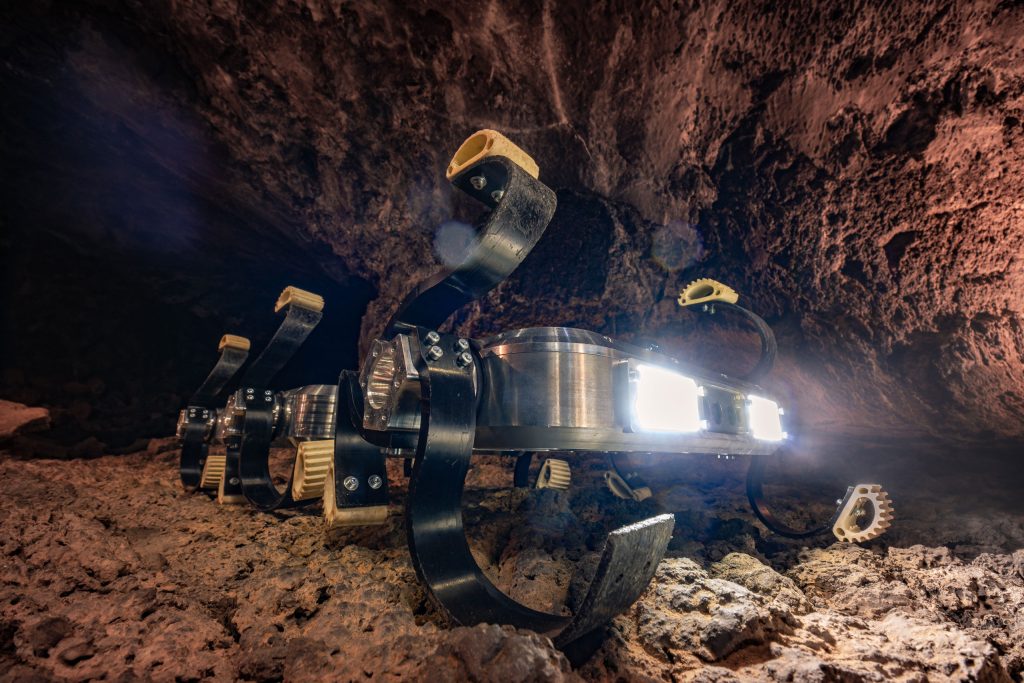
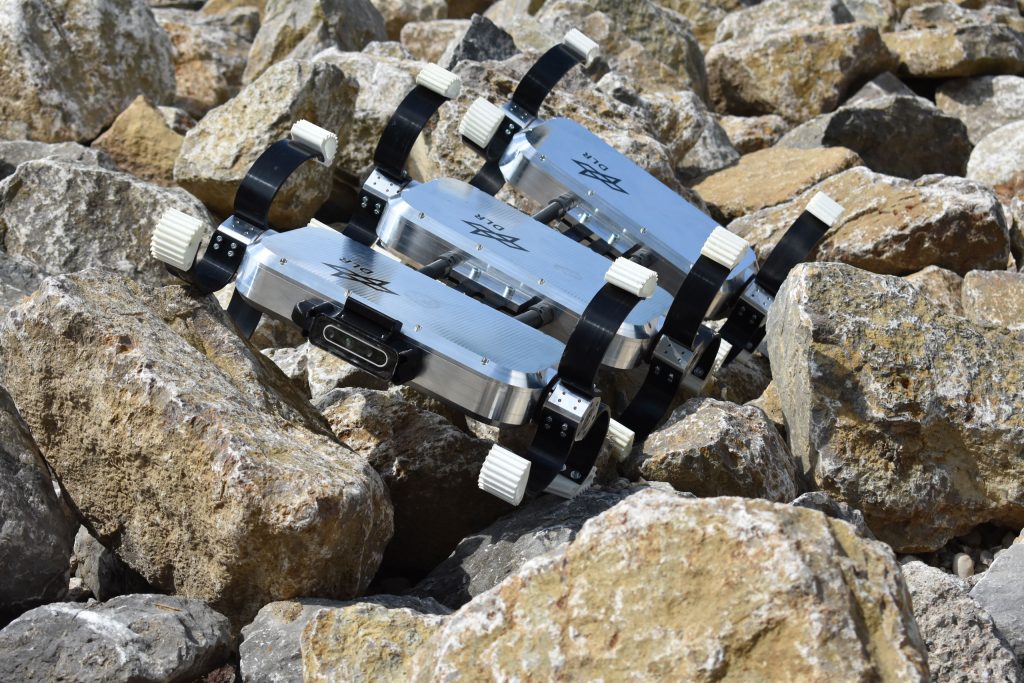
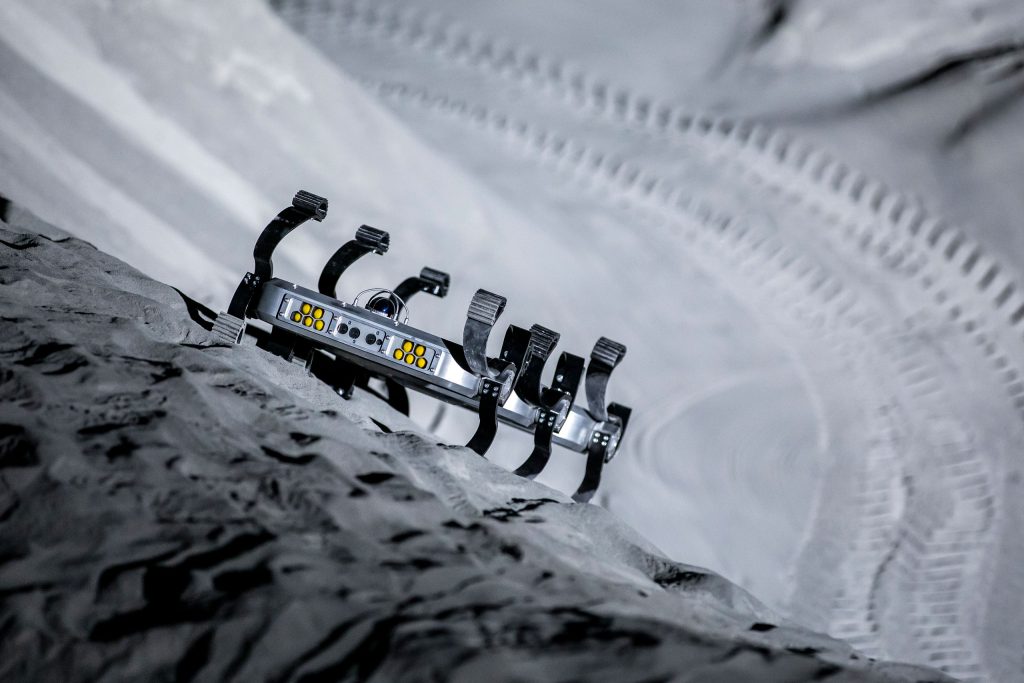
The Scout rover uses rimless wheels and has a modular design. It consists of a main module housing the control hardware, a set of actuators and batteries. Additional modules each contain a further set of actuators and offer space for over ten kilograms of payload. The baseline configuration uses three modules with six wheels.
The flexible spokes and ‘vertebrae’ connecting the three modules allow the Scout rover to adapt to uneven terrain and loose ground, while also providing the necessary shock absorption. The wheels are coordinated using bionic phase-shifting patterns to maximise off-road capability. The rover has been tested on Earth with drop heights of more than 1.5 metres. The spokes can be detached if they become stuck in the ground, and the system is also capable of self-righting from a sideways position. Only the essential actuators are used to reduce the number of potential failure points.
Further test campaigns are planned with drop heights of up to ten metres. The reduced gravity on Mars and the Moon will further improve the rover’s survivability in the event of a fall. Its exceptional impact resistance makes the Scout rover ideal for cave exploration, where even smart systems cannot always avoid minor incidents such as falling into a shaft or an abrupt step-like drop.
The aim of the project is to search for caves on celestial bodies such as the Moon or Mars and deploy a set of sensors there. An optical camera is also used to capture images in the visible spectrum for orientation and geographical context. Using a combination of the navigation suite with the communications modules, cave passages can be surveyed and mapped – similar to terrestrial cave exploration.
Link:
German Aerospace Center (Deutsches Zentrum für Luft- und Raumfahrt; DLR)
Institute of Robotics and Mechatronics
E-Mail contact-dlr@DLR.de