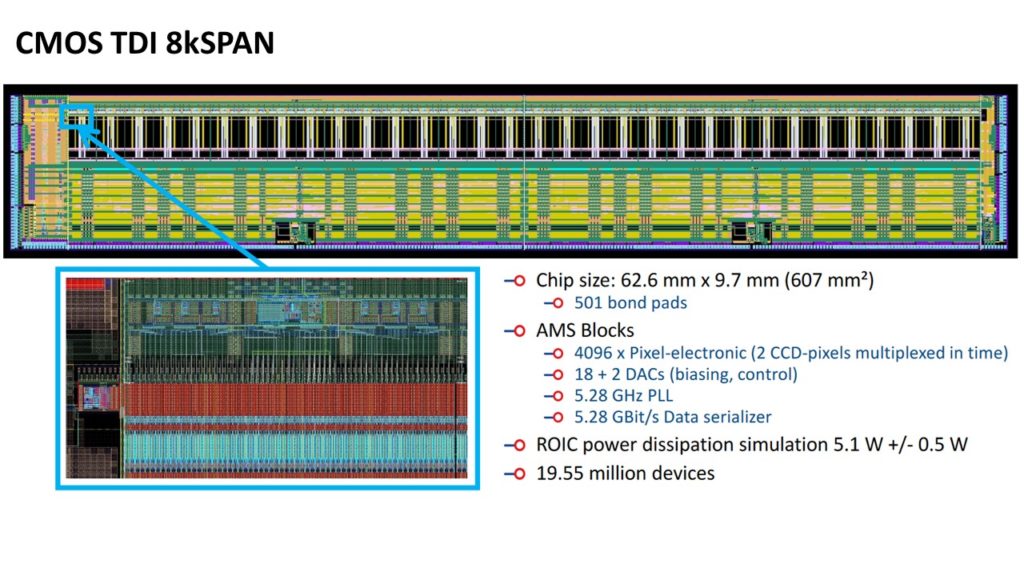
The Time Delay and Integration method improves the signal-to-noise ratio elevenfold (TDI-Step: 128). The design is based on CMOS technology and features 8000 pixels.
The Institute of Space Research at the German Aerospace Center (DLR) has over 40 years of experience in high-resolution imaging technology. At the Paris Airshow 2025, DLR is showcasing its scientific and technological achievements in a class of miniaturised systems based on the next generation of CMOS (complementary metal-oxide semiconductor) TDI (Time Delay and Integration) detectors.
This technology can be used for future space-based instruments offering medium to high and multispectral resolution. On-chip validation of the detector pixels in orbit over the entire mission lifetime ensures consistent performance throughout. These instruments have the potential to be integrated into a sensor network as part of a ‘system of systems’. The exhibited model of an 8000-pixel (8k) detector represents one possible implementation. The technology can also be adapted into 4k, 12k, 16k and 20k variants.
The detector was developed in collaboration with Jena Optronik GmbH, the Leibniz Institute for High Performance Microelectronics, the Fraunhofer Institute for Microelectronic Circuits and Systems IMS and the DLR Institute of Space Research.
Link:
German Aerospace Center (DLR)
Institute of Space Research
E-Mail contact-dlr@DLR.de